
When law firms in Georgia start comparing business phone systems, the conversation is about much more than features. It’s a critical evaluation of security, reliability, and ultimately, client trust. For practices managing attorneys in Atlanta or paralegals working remotely from Savannah, the right system—a modern VoIP or Unified Communications (UCaaS) platform—is the foundation of a secure, flexible, and productive firm. It provides the essential tools needed to protect client confidentiality while empowering your team, wherever they are.
Choosing Your Firm’s Next Business Phone System
For any Georgia law firm, from a bustling practice in Atlanta to a specialized boutique in Augusta, selecting a new phone system is a strategic decision that directly impacts client confidentiality, operational efficiency, and your professional reputation. This is especially true as more firms embrace hybrid models with remote attorneys and staff. Outdated landlines simply lack the security and flexibility to support a modern, distributed legal practice.
This guide provides a business phone systems comparison built for the unique compliance and security demands of the legal industry. We’ll explain in clear, business-friendly terms why solutions like Voice over Internet Protocol (VoIP) and Unified Communications as a Service (UCaaS) have become the gold standard for law firms that need to stay connected, compliant, and competitive.
Why VoIP is the Standard for Modern Law Firms
VoIP and UCaaS platforms deliver a level of security and flexibility that traditional analog systems cannot match. For a practice in Columbus or a partner working from their home office, these systems are essential for protecting sensitive client information and enabling seamless remote work.
Here’s why they’ve become so critical:
- Enhanced Security: Features like end-to-end encryption are built-in, protecting attorney-client privilege on every call and message.
- Unmatched Flexibility: Attorneys can use their official firm number from any device—a laptop softphone, a mobile app, or a desk phone—ensuring a professional presence from anywhere.
- Operational Resilience: Cloud-based systems aren’t tied to a physical office. Your firm stays online and reachable during local power outages or other disruptions, ensuring business continuity.
- Simplified Scalability: Adding a new line for a paralegal or setting up a new branch is a quick software adjustment, not a complex and expensive hardware installation.
Choosing a communications partner is just as important as choosing the technology. A provider like TelcoSolutions.net, with deep Georgia roots, understands the local legal landscape and ensures your system is configured for compliance right from the start.
Making the right choice requires a clear framework. This comparison is structured around the real-world challenges Georgia law firms face, from securing remote team communications to ensuring every client interaction is protected. A key part of the process is evaluating providers as much as their products. Get a head start by reviewing our vendor management best practices. The following sections offer a detailed analysis to help you select a system that secures your practice and empowers your distributed team.
What to Look for in a Legal Phone System
Before you compare business phone systems, you need a clear checklist. For a Georgia law firm, this isn’t about flashy features. It’s about securing the non-negotiables that protect your clients, your practice, and your reputation. A solid framework helps you cut through the marketing fluff and focus on what truly matters.
We’ve built this guide around three core pillars: security, reliability, and compliance. These are the fundamentals that ensure every client call—whether to your main office in Atlanta or an attorney working from home in Augusta—is handled with absolute integrity.
Security and Compliance First
In the legal world, security isn’t just a feature; it’s an ethical mandate. Protecting attorney-client privilege is paramount, so airtight security protocols should be the first thing you verify.
- End-to-End Encryption: Your system must encrypt everything—calls, voicemails, and messages. This is the only way to guarantee sensitive client information remains confidential.
- Compliance Features: Look for systems designed for the legal industry. This includes features like secure, compliant call recording (with clear consent functionalities) and detailed audit logs that track system access.
A phone system with weak security is a potential malpractice claim. The best platforms are designed with a security-first approach, giving you the peace of mind to focus on practicing law, not managing IT risks.
The demand for secure, flexible communication tools is growing rapidly. The global business phone systems market is expected to jump from USD 22 billion in 2024 to around USD 47 billion by 2033, largely driven by the shift to remote and hybrid work. For a deeper dive, you can explore the full market research on business phone systems.
Uptime and Reliability
A phone system that goes down is more than an inconvenience. It means missed client calls, lost billable hours, and a direct hit to your professional image. Rock-solid reliability is non-negotiable.
You need a provider that offers a Service Level Agreement (SLA) guaranteeing high uptime—the industry standard is 99.999%.
This reliability is directly tied to your firm’s internet connection. The best VoIP system is rendered useless by a shaky network. To ensure your connection is up to the task, see our guide on choosing the right business internet service.
Scalability and Integration
Your firm’s technology should enable growth, not hinder it. A scalable phone system allows you to add or remove users with a few clicks. Hiring a new paralegal in Savannah or an associate in Macon should be a simple software update, not a complicated hardware project.
Furthermore, seamless integration with the software you already use, like Clio or MyCase, is crucial. A system that automatically logs call details into your case management platform eliminates tedious manual entry, reduces errors, and makes your entire firm more efficient.
Comparing Top VoIP Providers for Georgia Law Firms
Making the right choice in a business phone system means looking beyond feature lists and focusing on how a provider performs in the real world of a legal practice. For a Georgia law firm, this is even more critical. It’s about prioritizing rock-solid security and getting support from a partner who understands your local needs.
Let’s break down how a dedicated Georgia-based partner like TelcoSolutions.net compares to large national players, focusing on what matters in your day-to-day operations—from protecting a sensitive client call to ensuring a paralegal has an intuitive way to manage discovery calls.
Security and Compliance Protocols
For any law firm, security is the absolute foundation. When one of your attorneys discusses a confidential case from their home office, that connection must be as secure as if they were in your main conference room.
-
TelcoSolutions.net (Local GA Partner): We lead with a security-first mindset. Every system we deploy is configured with end-to-end encryption for all calls and messages from the start. Our Georgia-based team understands the nuances of legal compliance and builds systems that support your ethical obligations.
-
National Providers: These providers offer robust security features, but the setup is often a generic, do-it-yourself project. A firm might get a powerful platform but lack the tailored configuration needed to meet specific state bar association guidelines without hiring an outside expert.
Legal-Specific Features and Usability
A phone system should make a lawyer’s life easier, not more complex. The right platform feels natural, whether for a tech-savvy associate or a senior partner who values simplicity and reliability.
-
TelcoSolutions.net: We focus on practical application. Our solutions integrate cleanly with legal software like Clio and MyCase, automating tasks like call logging. We provide hands-on training for your team to ensure everyone is comfortable from day one.
-
National Providers: They often boast a huge library of integrations, but setting them up can require dedicated IT staff. The sheer number of choices can be overwhelming without a clear implementation plan.
This chart shows how different pricing structures typically break down by monthly cost, contract terms, and what’s included.
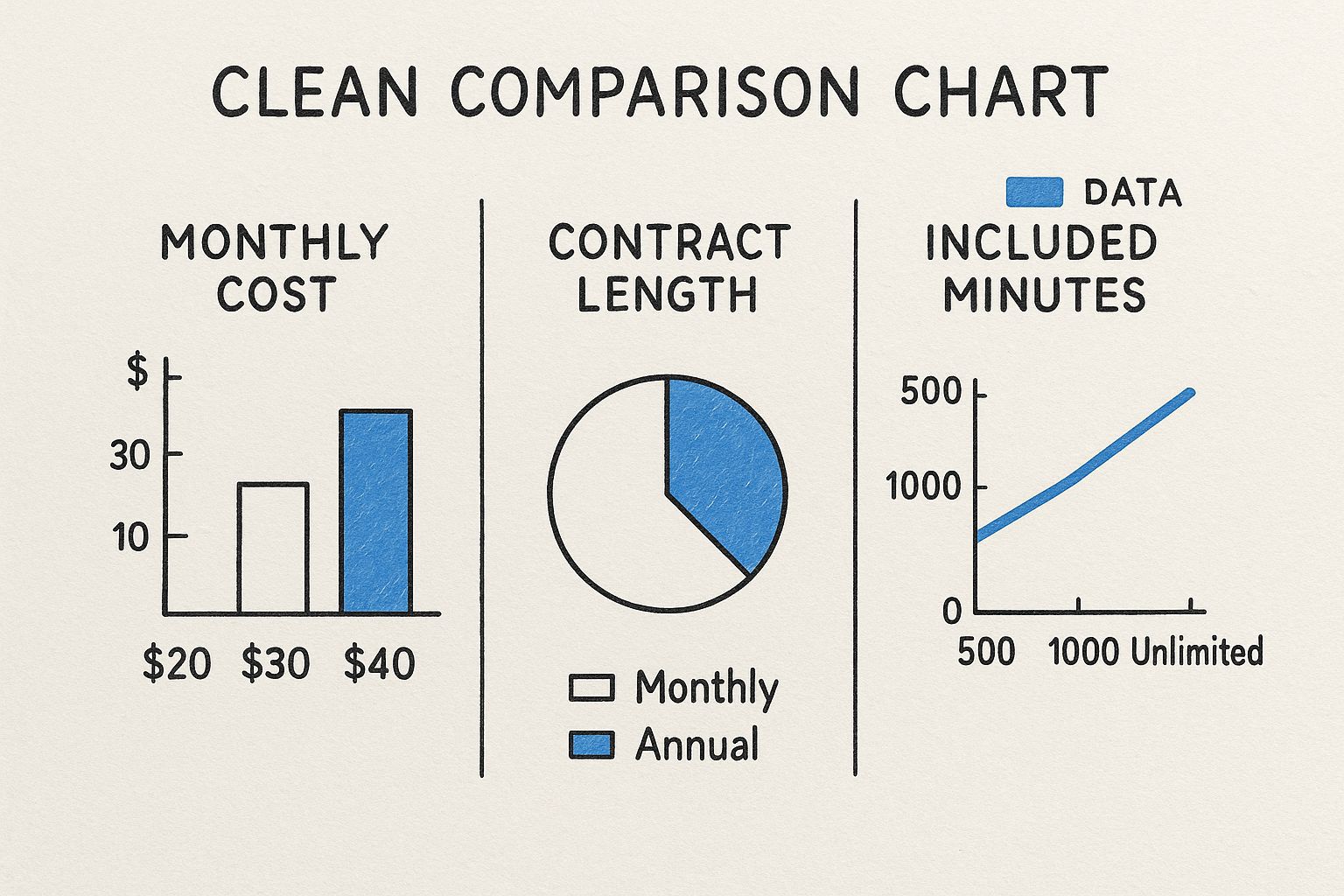
As you can see, there’s often a trade-off between a lower monthly price, which usually locks you into a longer annual contract, and the higher cost that comes with the flexibility of a month-to-month plan.
VoIP Provider Feature Comparison for Law Firms
To see how these differences play out, here is a side-by-side analysis of how leading providers meet the critical communication needs of a modern legal practice.
| Evaluation Criterion | TelcoSolutions.net (Local GA Partner) | National Provider A | National Provider B |
|---|---|---|---|
| Security Configuration | Pre-configured with end-to-end encryption and legal compliance settings. | Robust features available, but requires self-configuration or expert setup. | Strong baseline security; legal-specific tuning is manual and complex. |
| Legal Software Integration | Hands-on setup for key platforms like Clio & MyCase. | Large integration library, but often requires IT expertise to connect and maintain. | User-friendly interface, but advanced integrations can be limited or clunky. |
| Onboarding & Training | Personalized, on-site or virtual training for the entire firm. | Standardized online tutorials and group webinars. | Self-service setup guides with optional, paid support packages. |
| Ongoing Support | Direct access to a dedicated, Georgia-based expert who knows your account. | Tiered call center support with potentially long wait times. | Primarily chat/email support; phone access often reserved for premium tiers. |
This comparison highlights that while national providers offer powerful tools, a local partner is better positioned to deliver a solution that is truly optimized for a law firm’s specific needs from day one.
The Critical Difference Georgia-Based Support Makes
When your phone system has an issue, you need help immediately. The gap between a local Georgia-based team and a national call center can mean the difference between a minor blip and hours of lost billable time.
Imagine a critical system issue arises during a deposition for your Atlanta firm. A national provider puts you in a queue, connecting you to a generic agent reading from a script. In contrast, TelcoSolutions.net gives you a direct line to a Georgia-based expert who knows your system inside and out and can start resolving the problem immediately.
This personal, accessible support is a massive differentiator. For a law firm where every minute counts, having a local technology partner invested in your success offers invaluable peace of mind.
How VoIP Empowers Hybrid and Remote Law Firms in Georgia

For Georgia’s modern law firms, a hybrid or remote team is a strategic advantage. Modern VoIP (Voice over Internet Protocol) is the engine that makes this model work securely and efficiently. It becomes the central nervous system for a distributed legal practice, keeping every attorney, paralegal, and staff member connected.
This technology directly solves the biggest challenges of managing a team across different locations. For instance, a VoIP system lets an Atlanta-based attorney seamlessly handle client calls from their home office, the courthouse, or even during a power outage by automatically forwarding calls to their mobile phone. That’s a level of agility old landlines can’t match.
Unlocking Productivity From Any Location
A VoIP-powered phone system creates a unified office environment, no matter where your team logs in. It untethers your firm’s communications from a physical building, giving your staff the tools they need to stay productive from anywhere in Georgia.
An attorney in Columbus can use a softphone app on their laptop that works exactly like their desk phone, with full access to the firm’s directory, call history, and voicemail. This ensures they can serve clients just as effectively as if they were in the office. This flexibility is a key reason for the technology’s rapid adoption.
Maintaining Unwavering Professionalism
A distributed workforce should never mean a fractured professional image. VoIP systems ensure every client interaction is consistent and professional. Every outbound call—whether from a partner in Macon or a paralegal in Augusta—displays the firm’s main business number, not a personal cell phone.
A unified communication system protects your firm’s professional identity and your employees’ privacy. It creates a clear boundary between personal and professional communications, which is essential for compliance and work-life balance.
This unified presence is bolstered by features that project a polished image:
- Auto-Attendant: A virtual receptionist professionally greets callers and routes them to the right person, no matter their location.
- Voicemail-to-Email: Voicemails are transcribed and sent to an attorney’s email, allowing for quick, discreet responses.
- Business Hours Routing: Calls are automatically routed based on the time of day, ensuring clients always reach a live person or an appropriate message.
Driving Profitability And Business Continuity
Beyond productivity, VoIP delivers tangible financial benefits and makes your firm more resilient. By eliminating expensive on-premise hardware and maintenance contracts, firms can significantly reduce overhead.
Furthermore, a cloud-based system is inherently built for business continuity. During a severe storm in Savannah that knocks out power, your communication system stays running. Calls can be rerouted instantly to mobile devices or other locations, ensuring your firm never misses a beat. For a deeper dive into operational resilience, it’s worth reviewing best practices for network performance optimization. To further boost efficiency, law firms should also explore a wider set of top remote work tools.
The Importance of VoIP for Law Firms in Top U.S. Cities
Modern communication tools are essential for law firms aiming for a competitive edge in major metropolitan areas. For a practice in New York, a reliable VoIP system is crucial for connecting with international clients and maintaining operations in a fast-paced market. In Los Angeles, where traffic can disrupt schedules, VoIP provides the flexibility for attorneys to work productively from anywhere. Firms in Chicago benefit from the cost savings and scalability VoIP offers, allowing them to adapt quickly in a dynamic business environment. For legal practices in Houston, business continuity features ensure that communications remain active even during unpredictable weather events.
In Phoenix, a scalable VoIP solution allows a growing firm to add new attorneys without costly hardware installations. Similarly, a law firm in Philadelphia can leverage unified communications to connect multiple office locations seamlessly. For practices in San Antonio, VoIP’s professional features, like an auto-attendant, project a polished image to a diverse client base. In San Diego, the mobile capabilities of VoIP are perfect for attorneys who need to stay connected while on the move between court and client meetings. The ability to integrate with case management software is a major efficiency booster for firms in Dallas, while a practice in San Jose leverages the advanced technology to serve the city’s thriving tech industry.
Localized Q&A: Business Phone Systems
Q: How does VoIP help my law firm in Austin stay competitive?
A: In a dynamic market like Austin, VoIP gives your firm the agility to scale quickly. You can easily add lines for new staff and integrate with modern legal tech, ensuring you provide the responsive, tech-forward service clients expect.
Q: We have remote staff across the Jacksonville area. How does a new phone system support them?
A: A VoIP/UCaaS platform unifies your team. An attorney working remotely in Jacksonville has the same secure access to firm communications as someone in the office, using their business number from any device to maintain a professional presence.
Q: Is it difficult to switch phone systems for our firm in Fort Worth?
A: With a dedicated partner, the transition is seamless. We manage the entire process, including porting your existing Fort Worth numbers, to ensure zero disruption to your practice.
Q: What are the primary cost savings for a firm in Columbus?
A: Firms in Columbus can reduce costs by eliminating expensive on-premise hardware, maintenance contracts, and separate phone line charges. VoIP offers predictable, subscription-based pricing that scales with your needs.
Q: How does this technology protect client confidentiality for my Charlotte practice?
A: Security is paramount. For our clients in Charlotte, we implement systems with end-to-end encryption for all calls and messages, safeguarding attorney-client privilege and helping you meet ethical obligations.
Q: Our San Francisco firm needs to ensure 100% uptime. Is VoIP reliable enough?
A: Absolutely. Modern VoIP providers offer SLAs guaranteeing up to 99.999% uptime. For a market like San Francisco where every second counts, this reliability, combined with features like automatic call forwarding during an outage, ensures you never miss a critical call.
Q: Can we keep our established Indianapolis phone numbers?
A: Yes. We handle the entire number porting process to move your existing Indianapolis numbers to the new system without any downtime, ensuring continuity for your clients.
Q: How does a VoIP system scale as our Seattle firm grows?
A: Scalability is a core benefit. Whether you’re hiring a new paralegal or opening a new office in the Seattle area, adding users is a simple software change, allowing your system to grow effortlessly with your firm.
Q: What makes VoIP a good choice for the legal community in Denver?
A: For the dispersed legal community in Denver, VoIP provides the tools to connect remote attorneys and satellite offices into one cohesive system, improving collaboration and client service across the region.
Q: Our Washington D.C. firm deals with highly sensitive information. How secure is this?
A: Security is our top priority. For firms in Washington D.C., we deploy systems with robust end-to-end encryption and compliance features to ensure all communications are protected against unauthorized access.
Ready to modernize your law firm’s communications with a system designed for security, reliability, and remote productivity? TelcoSolutions.net is your Georgia-based partner for tailored phone and internet solutions that provide peace of mind.
Complete the form below to learn more.
PakarPBN
A Private Blog Network (PBN) is a collection of websites that are controlled by a single individual or organization and used primarily to build backlinks to a “money site” in order to influence its ranking in search engines such as Google. The core idea behind a PBN is based on the importance of backlinks in Google’s ranking algorithm. Since Google views backlinks as signals of authority and trust, some website owners attempt to artificially create these signals through a controlled network of sites.
In a typical PBN setup, the owner acquires expired or aged domains that already have existing authority, backlinks, and history. These domains are rebuilt with new content and hosted separately, often using different IP addresses, hosting providers, themes, and ownership details to make them appear unrelated. Within the content published on these sites, links are strategically placed that point to the main website the owner wants to rank higher. By doing this, the owner attempts to pass link equity (also known as “link juice”) from the PBN sites to the target website.
The purpose of a PBN is to give the impression that the target website is naturally earning links from multiple independent sources. If done effectively, this can temporarily improve keyword rankings, increase organic visibility, and drive more traffic from search results.