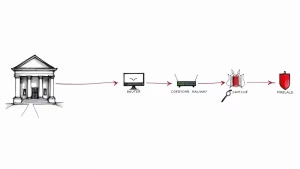
For Georgia-based law firms managing remote or hybrid teams, cybersecurity isn’t just an IT issue—it’s a fundamental aspect of modern legal practice. It involves a strategic blend of secure technology, clear policies, and continuous training designed to protect sensitive client data, safeguard firm information, and uphold your ethical duties. With attorneys and staff working from Atlanta to Savannah, ensuring every connection is secure is paramount to your firm’s reputation and success.
The New Front Line in Legal Practice Security
The shift to remote work has completely redrawn the security map for legal practices. For attorneys and office managers in small to mid-size Georgia law firms, protecting client confidentiality is no longer confined to the physical office. The new front line is digital, demanding a robust strategy that secures every remote connection and protects every piece of data, no matter where your team is located.
An unsecured home internet connection is the modern equivalent of leaving a client’s file on a public bench. The risk is just as real, and the consequences are just as severe.
Every email sent, every document accessed from a home office, and every client call taken over a personal device is a potential vulnerability. For firms with distributed teams, this expanded digital footprint requires a defense strategy built on secure, reliable communication tools. At TelcoSolutions.net, we provide the peace of mind that comes from knowing your firm’s communications are protected by a partner who understands the needs of Georgia businesses.
Upholding Your Ethical Duties in a Digital World
At its core, cybersecurity for law firms is about upholding your ethical duties of confidentiality and competence in an age where work can happen anywhere. The American Bar Association (ABA) is clear: lawyers must make “reasonable efforts” to prevent unauthorized access to client information. When your team is remote, “reasonable efforts” means building a technology foundation that’s secure from the ground up, starting with reliable phone services and secure internet.
This guide is designed to cut through the technical jargon and focus on what matters most to your Georgia firm: safeguarding client confidentiality while keeping your remote lawyers and staff productive and responsive. We’ll provide practical strategies to secure your practice, starting with the bedrock of any modern firm—secure communications delivered with dedicated, Georgia-based support.
Key Security Pillars for Remote Law Firms
To build a truly resilient practice, Georgia law firms need to focus on a few key areas. These aren’t just IT buzzwords; they are the pillars supporting the trust your clients place in you.
- Secure Communications: All client calls and internal discussions must be encrypted and private. Reliable VoIP phone services are non-negotiable for protecting attorney-client privilege.
- Reliable Connectivity: Your remote staff needs dedicated, secure internet access. Relying on public or shared home networks is a recipe for data interception and lost productivity.
- Data Protection: You need policies and tools that strictly control who can access sensitive files and from where. Access should be a privilege, not a default.
- Employee Awareness: Every single person on your team needs to be trained to spot and report threats like phishing emails. A well-trained team is your best human firewall.
By building on these pillars, you create a practice founded on digital trust. You’re not just protecting data; you’re partnering with TelcoSolutions.net to future-proof your firm for the challenges and opportunities ahead.
Why Cybercriminals Actively Target Your Law Firm
It’s a common misconception that cybercriminals only target large corporations in cities like New York or Los Angeles. The reality is that small and mid-size law firms, whether in Chicago, Houston, or right here in Georgia, are prime targets. Why? Because your firm is a treasure trove of high-value, sensitive information that attackers can exploit for financial gain.
Think about it. While a retail store might hold credit card numbers, your firm possesses data that can be used for identity theft, corporate espionage, or extortion. Understanding why you are an attractive target is the first step toward building a defense that truly protects your clients and your practice.
The Treasure Trove of Data You Protect
Cybercriminals are methodical. They follow the money, and for them, your data is as good as gold. Your firm stores several types of information that are highly valuable on the dark web.
- Personally Identifiable Information (PII): You hold everything needed for identity theft—names, addresses, Social Security numbers, and financial records for clients and staff.
- Confidential Client Communications: Attorney-client privilege is a cornerstone of your practice. To an attacker, these communications are powerful leverage for blackmail or corporate espionage.
- Sensitive Case Details: Information on mergers, intellectual property, or high-stakes litigation can be sold to competitors or used to manipulate markets.
- Trust Account Information: Gaining access to financial accounts allows criminals to drain funds before anyone realizes what’s happened. This is often the ultimate prize.
If you want to dig deeper into their motives, this article explains Why Cybercriminals Are Obsessed With Your Law Firm. It’s a sobering look into how hackers view your data not just as money, but as power.
The image below breaks down the most common ways criminals try to get their hands on this information, from phishing scams to full-blown ransomware attacks.
As you can see, it often starts with something as simple as a single deceptive email, which can quickly become the gateway to compromising your entire network.
From Phishing Emails to Ransomware Lockdowns
The most effective attacks aren’t always sophisticated assaults. More often than not, they begin with a simple trick targeting a busy employee who lets their guard down. Let’s look at a few of the most common threats law firms face.
Top Cybersecurity Threats Facing Law Firms in Phoenix and Beyond
Attackers have a whole arsenal of tools, but a few methods have proven especially effective against the legal sector in major hubs like Phoenix, Philadelphia, and San Antonio. Here’s a breakdown of the biggest threats.
| Threat Type | How It Works | Potential Impact on a Law Firm |
|---|---|---|
| Phishing/Spear Phishing | An attacker sends a deceptive email that looks legitimate to trick someone into revealing a password or clicking a malicious link. | A single click can lead to stolen credentials and unauthorized access to client files in your San Diego or Dallas office. |
| Ransomware | Malicious software encrypts all your critical files—case documents, client records—making them inaccessible until a ransom is paid. | Complete operational shutdown for your practice in San Jose or Austin, massive financial loss, and severe reputational damage. |
| Business Email Compromise (BEC) | Criminals impersonate a senior partner to trick staff into making unauthorized wire transfers. | Direct financial theft from firm or client trust accounts, a common threat for firms from Jacksonville to Fort Worth. |
| Insider Threats | A negligent employee accidentally leaks sensitive data or grants access to outsiders. | Loss of attorney-client privilege and potential malpractice claims for your firm, whether in Columbus, Charlotte, or San Francisco. |
| Data Breaches | Attackers exploit vulnerabilities in your network to steal large volumes of sensitive client and firm data. | Regulatory fines and a permanent loss of client trust for practices in Indianapolis, Seattle, Denver, and Washington D.C. |
These threats aren’t theoretical—they are happening to firms every single day. The consequences go far beyond a technical headache, striking at the heart of your firm’s finances, reputation, and ability to operate.
This isn’t a distant threat; it’s a direct and costly reality. The financial toll is staggering, and it’s growing every year.
Despite this clear and present danger, a shockingly low 34% of law firms had an incident response plan in place as of last year. This leaves the vast majority completely unprepared to handle an attack, forced to figure things out in the middle of a crisis.
The stakes are far too high to wait for an attack to happen. Recognizing that your firm is a prime target is the crucial first step. The next is to build a defense that protects your data, your clients, and your reputation from the ground up.
Building Your First Line of Digital Defense
Securing your firm’s daily communications is the bedrock of cybersecurity for law firms. A reliable, secure VoIP phone system and dedicated internet connection are the essential tools that keep your remote staff connected, productive, and compliant. For law firms in Georgia, these aren’t luxuries; they are necessities for protecting client confidentiality.
Without the right protections, voice traffic can be intercepted, exposing privileged discussions. A dedicated internet connection provides a private, high-speed lane for your data, ensuring guaranteed speed and reliability for your teams, whether they’re in the Atlanta office or working remotely across the state.
Secure VoIP Benefits for Georgia Law Firms
- End-to-end encryption keeps calls completely private from unauthorized listeners.
- Scalable lines let your firm seamlessly add attorneys as you grow.
- Cost-effective calling over the internet significantly reduces traditional phone bills.
Why VoIP is a Game-Changer for Businesses in New York and Los Angeles
In bustling legal markets like New York and Los Angeles, a reliable and scalable communication system is vital. VoIP (Voice over Internet Protocol) offers unparalleled flexibility, allowing remote attorneys and staff to stay connected as if they were in the office. Features like call forwarding to mobile devices, voicemail-to-email transcription, and virtual receptionists ensure that your firm remains professional and responsive, no matter where your team is located. This remote work capability is essential for attracting and retaining top talent in competitive cities.
The Role of Dedicated Internet Access
Unlike a standard internet connection where you share bandwidth, a dedicated circuit carves out a private pathway just for your firm’s data.
This guarantees the consistent upload and download speeds you need for crystal-clear video conferences and smooth eDiscovery tasks. Law firms in Georgia immediately notice fewer call drops and faster file transfers, which keeps productivity high.
Key Benefits of Dedicated Internet
- Predictable performance under high load, especially during trial preparation.
- Isolated connections reduce your firm’s exposure to traffic and threats from neighbor networks.
- Flexible bandwidth options that can be adjusted as your firm grows.
Aligning with Ethical Obligations
When you combine encrypted channels with dedicated, private links, you’re not just buying technology—you’re building a digital fortress. This proactive approach helps you meet ABA rules on competence and confidentiality and supports compliance with HIPAA, GDPR, and various state data privacy laws.
At the heart of any effective digital defense strategy lies robust Cyber Security Risk Management provided by industry experts. Law firms in Georgia can directly point to this infrastructure as a key factor in reducing breach risk and preserving their hard-earned reputation.
A scalable network design ensures your firm can handle sudden surges in data, like during trial prep or large document reviews. Adding more bandwidth should feel as simple as turning up a dial, not like a major office overhaul. A dedicated line means consistent, reliable performance for those crucial virtual depositions.
| Feature | Public Internet | Dedicated Internet |
|---|---|---|
| Bandwidth | Shared and variable | Guaranteed and exclusive |
| Security | Prone to interception | Encrypted and isolated |
| Scalability | Limited and congested | Flexible and on-demand |
Seeing the options side-by-side makes it clear why a dedicated connection is the right choice for protecting your firm’s remote workforce and justifying the investment to partners and clients.
- Tip: Always test your VoIP and internet with real-world calls and large file transfers before committing to a provider.
Putting It All Together
Your first line of defense—secure VoIP and dedicated internet—forms the backbone of your entire cyber strategy. These tools are working 24/7 to safeguard sensitive client data during every call, video conference, and file transfer. Investing in these services translates directly to less downtime and much stronger data protection.
The next logical step is to bring your VoIP and internet under a single managed service to simplify support and billing. A Georgia-based partner like TelcoSolutions.net provides that local expertise and can offer swift on-site assistance when needed. This approach drastically reduces the time it takes to resolve issues, keeping your firm agile and responsive.
- Benefit: Single billing and 24/7 support cut down on administrative overhead, freeing up your team to focus on billable work.
Combining services also strengthens your security posture by consolidating monitoring and patch management under one roof. Your remote teams will thank you for the clear, uninterrupted connections that let them work effectively from anywhere.
“Our calls are crystal clear and secure, even on trial days,” says a managing partner.
Next Steps for Your Firm
Ready to fortify your firm’s digital defenses? Complete the form below to see how much you could save while strengthening your security.
Our Georgia team will assess your current setup and recommend the right mix of secure VoIP and internet service for your specific needs. We deliver dedicated local support with a nationwide reach.
Protect client confidentiality and boost productivity with a digital defense built on a foundation of secure channels. Partner with TelcoSolutions.net and give your team the confidence to work securely from anywhere.
Actionable Security Policies for Remote Legal Teams
When your legal team is distributed, your security strategy has to stretch far beyond the walls of your central office. The policies you create for remote work aren’t just suggestions; they are the digital guardrails protecting client data, your firm’s integrity, and your ethical duties.
Think of every home office as a satellite branch of your firm. This simple shift in mindset changes the goal from just enabling remote access to actively securing it. It means setting crystal-clear rules for how firm data is handled, accessed, and protected, whether your team is in Georgia or across the country.
Securing Every Remote Endpoint
Here’s the first rule of cybersecurity for law firms: you can’t protect what you don’t control. Every single device connecting to your network—a laptop in Austin, a tablet in San Francisco, a smartphone in Indianapolis—is an “endpoint” that attackers can, and will, target.
Modern endpoint security is so much more than just antivirus software. It’s a whole suite of tools working together to prevent, detect, and respond to threats right on the device itself. This includes firewalls, intrusion prevention, and advanced malware detection, all designed to ensure a compromised personal device doesn’t become an open door to your firm’s most sensitive files.
For law firms managing remote teams, a clear device policy is non-negotiable:
- Firm-Issued Devices: Whenever you can, give employees firm-owned and managed laptops. This gives you total control over security settings, software updates, and who can access what.
- Mobile Device Management (MDM): When personal devices are used for work (the BYOD model), MDM software is a must. It lets you enforce security policies like strong passcodes and gives you the ability to remotely wipe firm data if a device is lost or stolen.
- Regular Patching: Make it mandatory for all software—from operating systems to applications—to be kept up-to-date. Attackers love to exploit known weaknesses in outdated software to sneak in.
The Non-Negotiable Role of MFA and VPNs
If endpoint security is the lock on each individual door, then Multi-Factor Authentication (MFA) and Virtual Private Networks (VPNs) are the armored gate and security checkpoint for your entire digital office.
Multi-Factor Authentication (MFA) is a deceptively simple yet incredibly powerful defense. It just means users have to provide two or more pieces of evidence to prove they are who they say they are—usually a password plus a code from their smartphone. Even if a cybercriminal steals a password, they’re stopped cold without that second factor.
A landmark study found that MFA can block over 99.9% of account compromise attacks. For a law firm, this makes MFA an absolute necessity for email, document management, and practice management systems.
A Virtual Private Network (VPN) creates a secure, encrypted tunnel over the internet, connecting a remote user directly and safely to the firm’s network. It’s like a private, digital corridor that shields all data from prying eyes, especially on public Wi-Fi at a coffee shop in Houston or an airport in Philadelphia. Your policy should be firm: all remote access to firm resources must go through the company VPN.
Turning Your Staff into a Human Firewall
Technology gives you the tools, but your team members are on the front lines using them every single day. The most advanced security system in the world can be defeated by one employee clicking on a convincing phishing link. This is precisely why ongoing cybersecurity training isn’t an expense—it’s a critical investment.
Ransomware attacks are a massive and growing threat to law firms. Attackers know how valuable legal data is and use it as leverage to demand huge ransoms. To fight back, experts recommend a few key safeguards: regular automated backups, advanced endpoint protection, and, most importantly, training your staff to spot the phishing attempts that are the most common entry point.
Effective training turns your staff from a potential vulnerability into a vigilant “human firewall.” Regular, engaging training sessions should cover the basics:
- Phishing Recognition: Teach employees how to spot suspicious emails, links, and attachments.
- Password Hygiene: Reinforce the importance of using strong, unique passwords for every system.
- Data Handling: Set clear rules for how to store and share sensitive client information.
- Incident Reporting: Create a simple, no-blame process for employees to immediately report anything that looks suspicious.
For firms with remote workers, a steady internet connection is just as vital as security. Our guide on backup internet for business continuity explains how to keep your team online and productive, even when the primary connection goes down.
Upholding Ethical Duties in a Digital Age
For any attorney, strong cybersecurity isn’t just a smart business decision—it’s a core ethical mandate. The rules of professional conduct haven’t changed, but the world around them certainly has. Protecting client confidentiality now extends far beyond locked file cabinets and deep into the digital realm of cloud servers, email inboxes, and remote connections.
This isn’t just good advice; it’s a responsibility explicitly outlined by the American Bar Association (ABA) and the State Bar of Georgia. Attorneys have a clear duty of technology competence and are required to take “reasonable efforts” to prevent unauthorized access to client information. Think of it less as an abstract guideline and more as a direct requirement to understand and use effective security measures.
Translating Ethical Rules into Concrete Actions
The duty of confidentiality, detailed in ABA Model Rule 1.6, means lawyers must safeguard all information related to a client’s representation. In today’s world, that means making sure your firm’s infrastructure—from your phone system to your network—is secure enough to protect attorney-client privilege.
Likewise, the duty of competence now includes technological competence. This means understanding the real-world risks that come with modern tech and taking proactive steps to shut them down. Let’s be clear: claiming ignorance of cybersecurity threats is no longer a viable defense.
- Duty of Confidentiality: Your firm needs to use encrypted communication channels (like secure VoIP) and protected networks (like VPNs) to stop eavesdropping and data interception cold.
- Duty of Competence: You have to understand the security features of the technology you use daily and ensure they are properly configured to shield client data.
Falling short of these standards doesn’t just put client data on the line; it exposes your firm to potential malpractice claims and disciplinary action. Strong cybersecurity for law firms has become a fundamental part of ethical practice.
Navigating Data Privacy and Compliance
Often, your ethical obligations overlap with strict legal and regulatory requirements. Depending on your practice areas, your firm might be handling data governed by privacy laws that carry staggering financial penalties for non-compliance.
For instance, if you represent clients in the healthcare industry, your communications and data storage must be HIPAA compliant. If you handle data for clients with customers in Europe, you could easily fall under the jurisdiction of the General Data Protection Regulation (GDPR).
These regulations aren’t just for massive corporations. A small firm in Georgia could easily handle data subject to these rules, making compliance a critical piece of your risk management strategy.
A breach involving this kind of protected data can trigger severe consequences, including hefty fines and mandatory public disclosure. The reputational damage can be irreparable.
Framing Security as an Ethical Investment
Looking at cybersecurity as just another IT expense completely misses the point. It’s a direct investment in your firm’s ethical integrity, client trust, and long-term survival. When you implement robust security measures, you’re building a foundation that ensures compliance and upholds your professional duties.
This approach gives your partners, associates, and—most importantly—your clients genuine peace of mind. It shows a deep commitment to protecting their most sensitive information, reinforcing the trust that is the bedrock of the attorney-client relationship. By prioritizing security, you’re not just protecting data; you’re safeguarding your firm’s reputation and honoring the ethical promises you make to every client.
Why a Local Security Partner Matters
When you’re up against sophisticated digital threats, your choice of technology partner is just as critical as your legal strategy. For a law firm here in Georgia, a local partner like TelcoSolutions.net brings a distinct, tangible advantage. We aren’t just a vendor; we’re part of the same business community, and we understand the specific challenges and opportunities that Georgia law firms face with remote and hybrid workforces.
This local insight means we’re a strategic partner invested in your firm’s success. When an issue arises, you’re not just a ticket number in a massive queue. You get a fast, on-the-ground response from a team that knows your community and provides personal, attentive service—a key differentiator that instills confidence.
The Advantage of Georgia-Based Support
Working with a local team delivers practical benefits that directly impact your firm’s security and efficiency. We bring a nuanced understanding of the Georgia legal landscape, from compliance expectations to the unique connectivity challenges across the state.
This local knowledge ensures the cybersecurity solutions for law firms we implement are perfectly aligned with your operational needs. Our reliable phone and internet services are built to provide the robust security a modern Georgia law firm needs to thrive, keeping your remote teams productive and protected.
Choosing a local technology partner like TelcoSolutions.net transforms your communications from a generic expense into a strategic asset. You gain a collaborator who is accountable, accessible, and aligned with your firm’s goals for growth and security.
A Partner in Your Firm’s Success
Our goal is to give your firm genuine peace of mind. We deliver communication and internet solutions that act as a digital fortress, safeguarding client data and helping you uphold your ethical duties without a second thought. Our proactive approach is designed to prevent disruptions before they happen, keeping your team productive, responsive, and secure.
To get a better handle on keeping operations running smoothly even during an outage, check out our guide on creating a network disaster recovery plan. It’s a crucial piece of any complete security strategy.
Ready to see how a local partnership can fortify your practice? Complete the form below to learn more about protecting your firm with solutions built specifically for Georgia’s legal community.
Localized Q&A: Telecom Questions for US Law Firms
Q: Why is reliable telecom service crucial for my law firm in Chicago and Houston?
A: In fast-paced legal environments like Chicago and Houston, dropped calls or slow internet can mean missed deadlines and frustrated clients. Reliable telecom services ensure your team can collaborate seamlessly, participate in virtual court proceedings without interruption, and maintain the professional image your clients expect. It’s the backbone of productivity for any modern firm.
Q: How can modern phone systems benefit my distributed team in Phoenix and Philadelphia?
A: For firms with remote workers in cities like Phoenix and Philadelphia, a modern VoIP system is essential. It allows your staff to make and receive calls from their business line on any device, anywhere. This keeps personal numbers private and ensures a consistent, professional presence, whether they are in the office or working from home.
Q: My firm operates in San Antonio and San Diego. What are the cost benefits of VoIP?
A: Firms in markets like San Antonio and San Diego can see significant cost savings with VoIP. By using your internet connection for calls, you can eliminate expensive traditional phone line contracts and reduce long-distance charges. The scalability also means you only pay for the lines you need, making it a cost-effective solution as your firm grows.
Q: What should my firm in Dallas and San Jose look for in a telecom provider?
A: When choosing a provider in competitive tech hubs like Dallas and San Jose, look for a partner that offers more than just a dial tone. Prioritize providers that offer robust security features like end-to-end encryption, guaranteed uptime (SLA), and responsive, expert support. A true partner will understand the unique compliance and security needs of law firms.
Ready to fortify your firm’s digital defenses with a partner who understands your needs? TelcoSolutions.net delivers secure, reliable communication and internet solutions designed for Georgia’s legal community.
Complete the form below to learn more.
PakarPBN
A Private Blog Network (PBN) is a collection of websites that are controlled by a single individual or organization and used primarily to build backlinks to a “money site” in order to influence its ranking in search engines such as Google. The core idea behind a PBN is based on the importance of backlinks in Google’s ranking algorithm. Since Google views backlinks as signals of authority and trust, some website owners attempt to artificially create these signals through a controlled network of sites.
In a typical PBN setup, the owner acquires expired or aged domains that already have existing authority, backlinks, and history. These domains are rebuilt with new content and hosted separately, often using different IP addresses, hosting providers, themes, and ownership details to make them appear unrelated. Within the content published on these sites, links are strategically placed that point to the main website the owner wants to rank higher. By doing this, the owner attempts to pass link equity (also known as “link juice”) from the PBN sites to the target website.
The purpose of a PBN is to give the impression that the target website is naturally earning links from multiple independent sources. If done effectively, this can temporarily improve keyword rankings, increase organic visibility, and drive more traffic from search results.